
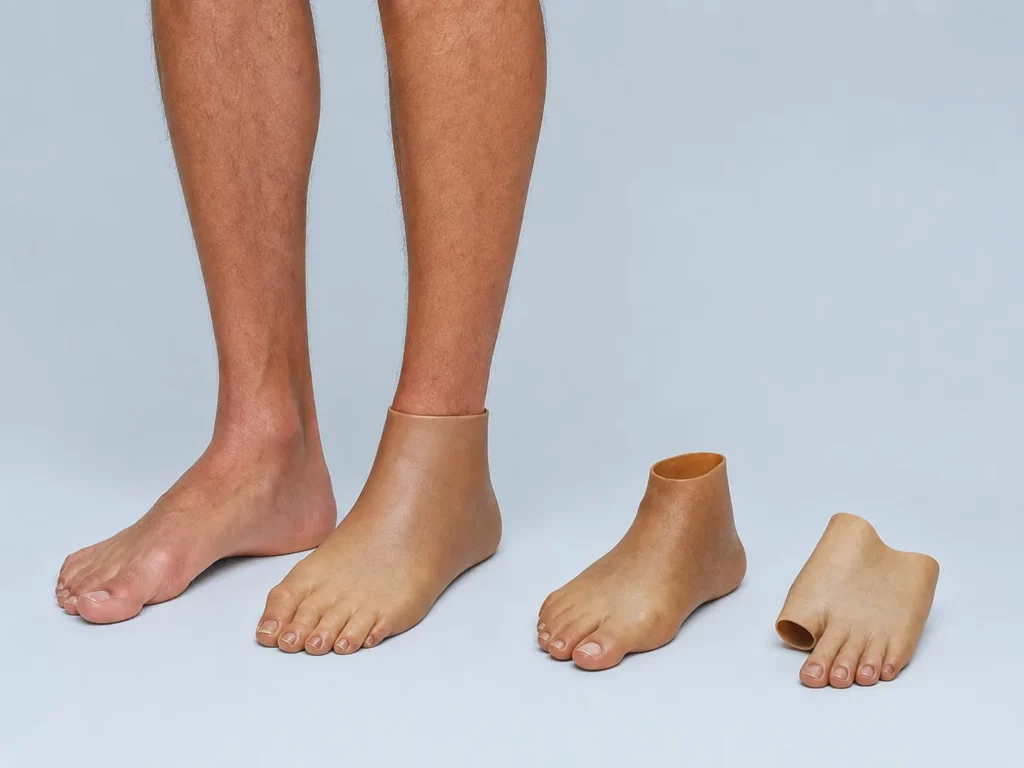
Prosthesis designed to replace a missing part of the foot and support everyday movement
The custom-made partial foot prosthesis is intended for people who have undergone an amputation of part of the foot or one or more toes.
It aims to improve weight-bearing, stability and the rolling movement of the foot. It may also provide greater comfort during walking.
A partial foot prosthesis replaces the missing part of the foot. It can be adapted to different amputation levels according to each person’s situation.
The prosthesis is custom-made. Its design takes into account the shape of the remaining foot, the condition of the skin, sensitive areas and mobility needs.
Depending on the model, it can restore the missing volume inside the shoe. It can also help distribute pressure more evenly during walking.
Some silicone prostheses may support a smoother rolling movement of the foot. Their adjusted shape helps keep the prosthesis securely positioned around the remaining part of the foot.
The choice of solution depends on the level of amputation and the condition of the foot. The team also considers the person’s footwear, daily activities and personal goals.
At OrthoGreen Mobility, an orthopaedic centre and bandagist in Molenbeek-Saint-Jean, Brussels, we support you throughout the process. Our team provides measurement, fitting, adjustment and follow-up services.
Partial foot amputation
Amputation of one or more toes
Forefoot amputation
Need to replace a missing part of the foot
Need to improve weight-bearing while walking
Need for greater stability
Need for improved pressure distribution
Difficulty keeping the foot correctly positioned inside the shoe
Renewal of an existing prosthesis
Changes in the shape or volume of the remaining foot
Use following a medical and orthopaedic assessment
A partial foot prosthesis must be fitted accurately. A precise fit contributes to comfort and stability.
Our team assesses your foot, walking pattern and daily habits. We then recommend a solution suited to your situation.
Regular follow-up helps monitor pressure areas. It also allows the prosthesis to be adjusted as your needs change.