
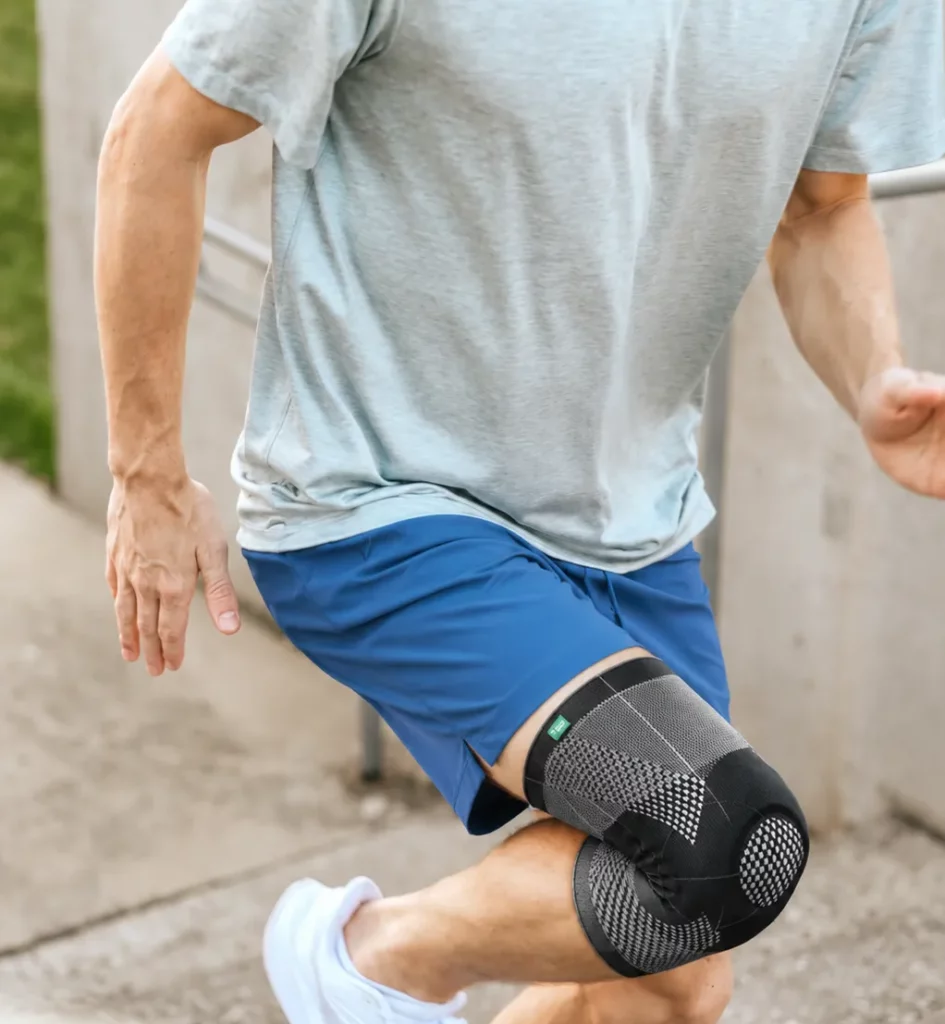
Physical activity is important for maintaining mobility, strengthening the muscles and supporting overall health. However, running, hiking, team sports and intensive training can sometimes cause pain in the knees, ankles, feet, back or other joints.
This does not necessarily mean that sport must be stopped permanently. Joint pain can appear after increasing training intensity too quickly, insufficient recovery, a previous injury or the use of unsuitable equipment.
Depending on the situation, a knee support, orthosis, ankle brace, orthopaedic insoles or another support device may help during physical activity. However, the equipment should be selected according to the painful area, the type of activity and the recommendations of a healthcare professional.
Why can sport cause joint pain?
During running and certain sporting activities, the joints must absorb and transfer significant forces. At the knee, these forces can briefly reach several times the person’s body weight.
The body is generally able to adapt to these demands when activity is increased progressively. Pain is more likely to occur when the training load exceeds the person’s recovery capacity.
Several factors may contribute to joint pain:
Increasing distance or intensity too quickly
Insufficient recovery between training sessions
Returning to sport too quickly after a period of inactivity
Poor positioning of the foot or knee
Muscle weakness
Worn or unsuitable footwear
A previous injury
Poorly controlled running technique or repetitive movements
An existing joint condition
The location of the pain and the circumstances in which it appears should be considered before choosing a support device.
Can a knee support help during sport?
A knee support is one of the most commonly used devices for discomfort, pain or a feeling of instability around the knee.
It may provide a sense of support, compression and security during movement. Depending on its design, it may also support the kneecap or help control certain movements of the joint.
Elastic knee support
An elastic knee support provides light compression around the joint. It may be suitable for people looking for flexible support during physical activity.
It may be considered in cases of:
Mild joint discomfort
A feeling of weakness
A gradual return to sport
A need for compression during exercise
A desire for better awareness of the knee’s position
However, an elastic support does not replace a stabilising orthosis when there is a significant injury or pronounced joint instability.
Patellar knee support
A patellar knee support is designed to support the area around the kneecap. It may be recommended in certain cases of pain at the front of the knee, particularly during running, climbing stairs, bending or jumping.
The choice of support depends on the cause of the pain and should ideally follow a professional assessment.
Stabilising knee orthosis
A more structured knee orthosis may be recommended when stronger support is required. It may include lateral reinforcements or articulated components designed to control certain movements more effectively.
Depending on medical advice, it may be considered for:
Ligament instability
Recovery after an injury
A gradual return to sporting activity
Follow-up after surgery
A need to limit or control certain movements
Correct sizing and adjustment are essential to avoid an orthosis that is too tight, too loose or incorrectly positioned.
Which equipment can help the ankles and feet?
The ankles are particularly stressed during sports involving changes of direction, jumping or uneven ground.
Ankle brace
An ankle brace may provide light compression or stronger support, depending on the type selected. It may be used when returning to sport, in cases of instability or after certain ankle sprains, following professional advice.
An unsuitable ankle brace may restrict movement or create pressure points. It should therefore be selected according to the required level of stability and the activity being performed.
Orthopaedic insoles
Orthopaedic insoles may help distribute pressure under the foot and support the alignment of the lower limb.
They may be considered when the person’s foot position or walking pattern affects comfort during sport. Their suitability depends on the individual’s body shape, footwear, sporting activity and the origin of the pain.
A personalised assessment is generally preferable to the systematic use of standard insoles.
What about the wrist, elbow or back?
Racket sports, strength training, cycling and repetitive activities can also place strain on the wrists, elbows and back.
Depending on the situation, different devices may be considered:
A wrist orthosis or splint
An elbow support
A support bandage
A lumbar support belt
A stabilising device adapted to the affected joint
These products may provide temporary support, but they should not be used simply to hide significant pain and continue training without an assessment.
How should suitable medical equipment be selected?
The choice should not be based only on the appearance of the product or the affected joint. Two people with knee pain may require completely different forms of support.
Several factors should be assessed:
The precise location of the pain
The movements that trigger the symptoms
The presence of swelling
A feeling of instability
Previous injuries or surgery
The sport being practised
The frequency and intensity of training
The user’s body shape
The required level of support
Medical advice or prescription
The device should remain comfortable, should not increase the pain and should not excessively restrict circulation or the movements required for the activity.
Mistakes to avoid
Wearing an orthosis or knee support does not always address the underlying cause of joint pain.
It is generally advisable to avoid:
Choosing a size that is too small to obtain more compression
Continuing to exercise despite severe pain
Using an orthosis to hide symptoms
Returning directly to intensive training after an injury
Wearing a device in the wrong position
Neglecting muscle strengthening and recovery
Continuing to use equipment that causes irritation or painful pressure points
An orthosis is usually more effective when it is part of a broader approach that includes adapting the activity, returning progressively and undergoing rehabilitation when necessary.
When should you seek medical advice?
It is advisable to stop the activity and seek medical advice when the pain is severe or unusual.
A consultation is particularly recommended in cases of:
Significant swelling
Inability to put weight on the leg
A locked joint
Repeated giving way of the joint
Visible deformity
Pain following a significant injury
A red, hot or severely swollen knee
Pain that does not improve with rest and modification of the activity
An assessment can help identify the cause of the pain before returning to sport or selecting a medical device.
Personalised advice in Molenbeek
At OrthoGreen Mobility, we assist you in choosing a knee support, orthosis, ankle brace, orthopaedic insoles or another support device suited to your needs.
Our team considers the affected joint, your body shape, the sport you practise, the required level of support and any medical prescription you may have.
Visit our bandagist and medical equipment store in Molenbeek-Saint-Jean, Brussels, for personalised advice.
Do you experience pain during sport or are you looking for a suitable support device? Contact us for advice or to make an appointment.
This article provides general information and does not replace a medical consultation or diagnosis.