
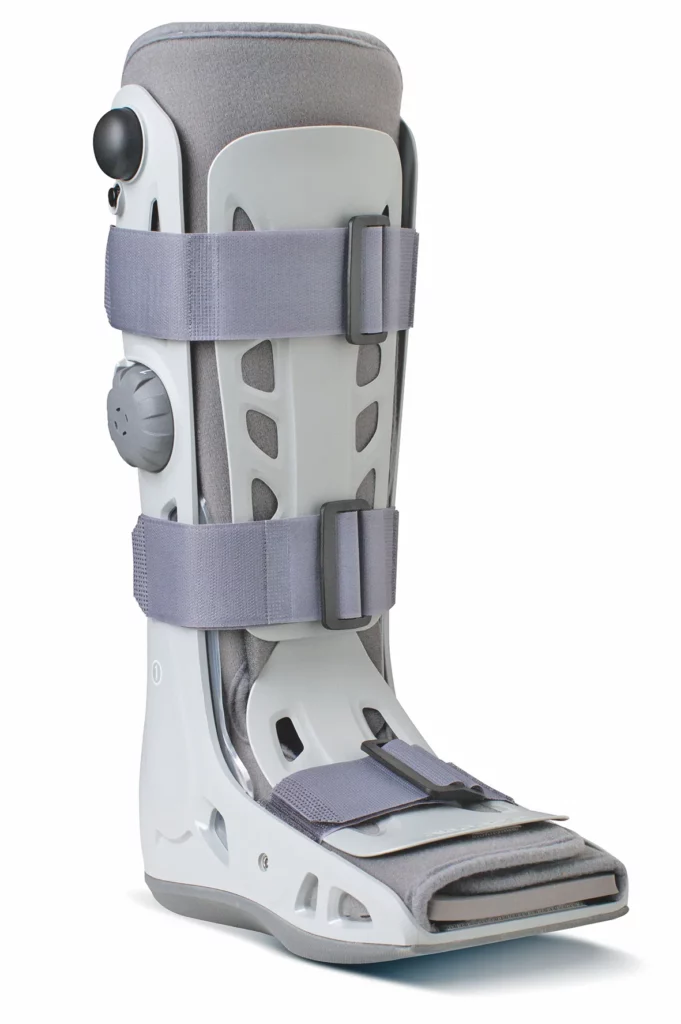
High walking boot designed to immobilise the foot, ankle and lower leg
This orthopaedic walking boot protects the foot and ankle during recovery. It provides firm support after an injury or surgery. Walking should only begin when approved by a healthcare professional.
The orthopaedic walking boot immobilises the foot, ankle and lower leg. It limits movements that could delay recovery.
Its semi-rigid shell protects the injured area and keeps the leg stable. Adjustable straps also allow the fit to be adapted to the user.
Inflatable support areas provide extra compression around the ankle. They can be adjusted when swelling changes during the day.
The curved sole supports a smoother rolling movement of the foot. Therefore, it may make walking easier when weight-bearing is allowed. Always follow the instructions given by the doctor or specialist.
The outer sole provides grip on suitable surfaces. The open structure also improves ventilation and makes it easier to check the skin.
Choosing the correct size is essential. A boot that is too tight may cause pain, pressure or numbness. A loose boot may not provide enough stability.
At OrthoGreen Mobility, an orthopaedic bandagist in Molenbeek-Saint-Jean, Brussels, we help you choose and adjust a walking boot suited to your prescription.
Stable foot fracture
Stable ankle fracture
Stable lower-leg fracture
Severe ankle sprain
Immobilisation after surgery
Protection after trauma
Need for high and reinforced support
Controlled walking during recovery
Use according to a medical prescription
The correct orthopaedic walking boot depends on the injury and the required level of immobilisation. The size of the foot and the shape of the leg are also important.
The heel must remain at the back of the boot. The straps should then secure the leg without causing pain or numbness.
Our team can check the size, fastening tension and stability while walking. We also explain how to put on, remove and adjust the boot correctly.